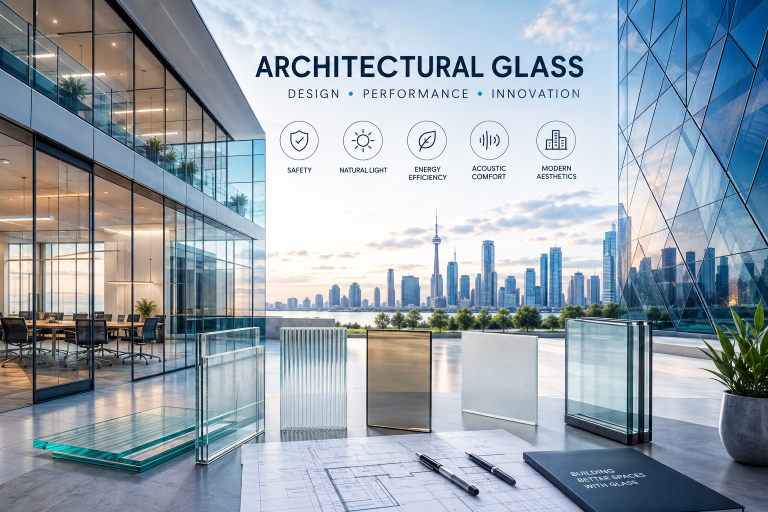
Architectural glass plays an essential role in modern building design, combining aesthetics, natural light, safety, energy performance, and functionality. From expansive building façades and curtain walls to interior partitions, railings, skylights, and decorative features, glass gives architects and designers exceptional flexibility.
But architectural glass is much more than standard window glass. Modern architectural glass can be laminated, insulated, tempered, textured, curved, coated, printed, or combined with advanced technologies to meet specific performance and design requirements.
In this guide, we explore what architectural glass is, the most common types, where they are used, their key benefits, and what architects, designers, and builders should consider when selecting glass for a project.
What Is Architectural Glass?
Architectural glass is glass specifically designed and manufactured for use in buildings and architectural applications.
Depending on the project, it may serve structural, decorative, safety, security, acoustic, privacy, daylighting, or energy-performance purposes.
Architectural glass is commonly used in:
- Building façades and curtain walls
- Office partitions and conference rooms
- Entrances and storefronts
- Glass railings and balustrades
- Skylights and canopies
- Healthcare environments
- Hotels and hospitality spaces
- Retail environments
- Educational and institutional buildings
- High-end residential projects
The right architectural glass solution depends on the building’s design, location, performance requirements, scale, and intended application.
Types of Architectural Glass
There is no single type of architectural glass suitable for every project. Modern buildings often combine multiple glass technologies to achieve the required appearance, safety, privacy, energy efficiency, and performance.
1. Tempered Glass
Tempered glass, also known as toughened glass, undergoes a controlled heat-treatment process that increases its strength compared with conventional annealed glass.
If broken, tempered glass is designed to fragment into relatively small pieces rather than large sharp shards, making it suitable for many safety-glazing applications.
Common applications include:
- Glass doors
- Storefronts
- Interior partitions
- Railings
- Commercial entrances
- High-traffic areas
Tempered glass can also be incorporated into more complex architectural glass configurations depending on project requirements.
2. Laminated Glass
Laminated glass consists of two or more layers of glass bonded together with an interlayer.
If the glass breaks, the interlayer helps hold the fragments together rather than allowing them to scatter.
This makes laminated glass an important architectural solution where safety and security are key considerations.
Common applications include:
- Glass railings
- Skylights
- Storefronts
- Doors and entrances
- Office partitions
- Overhead glazing
- Security glazing
Certain laminated configurations can also provide improved acoustic performance and UV protection.
3. Insulated Glass Units (IGUs)
Insulated glass units consist of multiple panes of glass separated by a sealed air or gas-filled space.
These systems are widely used in exterior architectural applications because they can improve thermal performance and help reduce heat transfer through the building envelope.
Depending on the configuration, insulated glazing can also incorporate solar-control coatings, decorative components, meshes, timber elements, or other technologies.
For architects designing commercial façades and energy-conscious buildings, high-performance IGUs can play an important role in overall building performance.
4. Smart Glass and Privacy Glass
Smart glass allows glazing to change its appearance or light-transmission properties.
Switchable privacy glass can transition between transparent and private states, allowing architects to create flexible spaces without relying on conventional blinds or curtains.
SmartGlass solutions can be particularly useful for:
- Conference rooms
- Executive offices
- Healthcare facilities
- Hospitality environments
- Interior partitions
- Residential spaces
Specialized configurations can provide different visual effects, including clear-to-whiteout and clear-to-blackout SmartGlass, depending on the desired privacy and design requirements.
5. Decorative, Patterned and Textured Glass
Architectural glass can also become an important visual feature of a building.
Decorative, patterned, textured, cast, etched and printed glass allows designers to manipulate transparency, privacy, light, color and texture.
Applications include:
- Feature walls
- Reception areas
- Office interiors
- Hotel lobbies
- Retail environments
- Restaurants
- Decorative partitions
- Residential interiors
With numerous textures, colors, patterns and fabrication options available, architects can create highly customized glass configurations for individual projects.
6. Acoustic Glass
Noise control is increasingly important in offices, hotels, healthcare facilities, residential buildings and commercial projects in busy urban environments.
Acoustic glazing can use specialized laminated configurations, different glass thicknesses, insulated units, or combinations of these technologies to reduce sound transmission.
It can be particularly useful for:
- Office meeting rooms
- Conference spaces
- Hotels
- Healthcare environments
- Educational facilities
- Residential buildings near busy roads
- Commercial buildings in urban areas
The appropriate glass configuration should be selected according to the project’s required acoustic performance.
7. Security, Bullet, Blast and Impact Glass
Some architectural projects require significantly higher levels of protection.
Specialized security glazing systems can be engineered for resistance to impact, forced entry, blast loads, and ballistic threats, depending on the required specification and tested configuration.
Applications may include:
- Banks
- Government facilities
- Luxury retail
- Secure entrances
- Public buildings
- High-security commercial environments
- Critical infrastructure
Security glass should always be selected according to the specific performance requirements and applicable standards of the project.
8. Channel Glass
Channel glass is a distinctive architectural glazing system consisting of U-shaped cast glass channels.
It can introduce diffused natural light while providing privacy and creating a strong architectural feature.
Channel glass can be used for:
- Exterior façades
- Interior partitions
- Feature walls
- Stairwells
- Daylighting applications
- Commercial and institutional buildings
Its continuous appearance gives architects a different visual option from conventional flat glazing.
9. Curved Architectural Glass
Curved glass allows architects to move beyond conventional flat façades and introduce flowing forms into modern buildings.
Applications can include:
- Curved façades
- Feature entrances
- Curved windows
- Glass railings
- Atriums
- Commercial feature walls
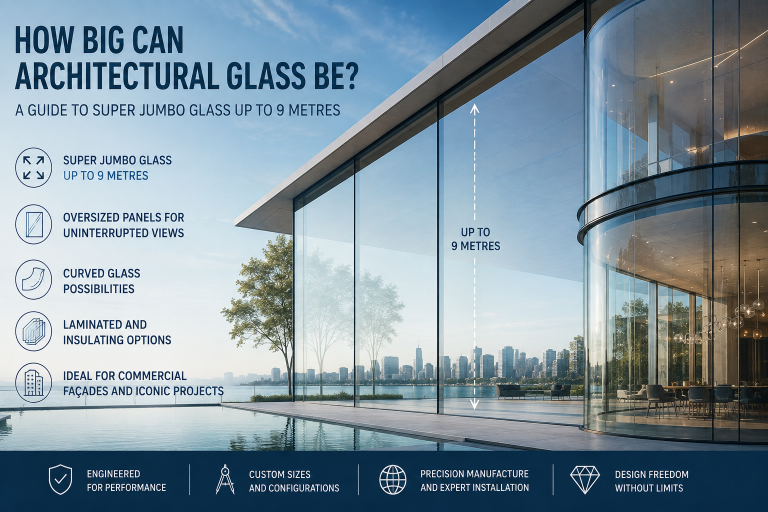
For ambitious projects, large-format and Super Jumbo curved glass can create expansive curved surfaces while minimizing visual interruptions between panels.
10. Oversized and Super Jumbo Glass
Large-format architectural glass is increasingly used to create transparent façades, dramatic entrances, atriums and other uninterrupted glazed surfaces.
Depending on the project and required configuration, Super Jumbo glass can reach sizes of up to 9 metres, opening new possibilities for large-scale architectural design.
Oversized glass can help reduce the number of joints and framing divisions required across a façade, creating a cleaner and more continuous appearance.
Interior vs. Exterior Architectural Glass
One of the first considerations when specifying architectural glass is whether it will be used for an interior or exterior application.
Interior Architectural Glass
Interior applications commonly prioritize:
- Transparency
- Privacy
- Acoustics
- Safety
- Natural light
- Aesthetics
Typical applications include office partitions, conference rooms, decorative walls, doors, privacy glass, railings and reception areas.
Smart glass, laminated glass, decorative glass and acoustic glazing can all be considered for these environments.
Exterior Architectural Glass
Exterior glazing faces additional requirements because it is exposed to weather, temperature changes, solar radiation and other environmental conditions.
Applications include:
- Curtain walls
- Building façades
- Storefronts
- Skylights
- Canopies
- Exterior railings
- Entrances
For these projects, architects may need to consider thermal insulation, solar heat gain, safety, structural performance, durability and appearance.
Key Benefits of Architectural Glass
Natural Light
One of the greatest advantages of architectural glass is its ability to introduce daylight into buildings.
The right glazing configuration can help create brighter and more comfortable interior environments while reducing dependence on artificial lighting.
Energy Performance
Insulated glass, Low-E coatings and other high-performance glazing technologies can help manage heat transfer and solar gain.
This can contribute to the overall energy-performance strategy of a building.
Safety and Security
Tempered, laminated, impact-resistant and specialized security glass can help architects meet different safety and protection requirements.
Privacy
Glass does not always need to be completely transparent.
Textured, decorative and switchable privacy glass can provide different levels of visual privacy while maintaining access to natural light.
Acoustic Performance
Specialized glass configurations can help reduce sound transmission between spaces or from busy exterior environments.
Design Flexibility
Color, transparency, reflectivity, texture, pattern, curvature and scale can all dramatically influence the appearance of architectural glass.
Custom glass configurations also allow architects to combine different technologies and materials to meet both aesthetic and technical requirements.
How to Choose the Right Architectural Glass
Choosing architectural glass should begin with the project’s performance requirements rather than appearance alone.
Architects, designers, engineers and glazing contractors should consider:
Safety: Where will the glass be installed and what safety requirements apply?
Energy performance: Does the project require thermal insulation or solar-control performance?
Acoustics: Is sound reduction important for the building or interior space?
Privacy: Should the glass remain transparent, provide permanent privacy, or switch between different states?
Security: Does the project require resistance to impact, forced entry, blast, or ballistic threats?
Natural light: How much daylight should enter the space, and how will glare and heat gain be controlled?
Size and geometry: Does the design require oversized, Super Jumbo, curved, or custom-shaped glass?
Aesthetics: What colors, textures, patterns, meshes, coatings, or decorative effects are required?
Why Architectural Glass Specification Matters
Selecting glass early in the design process can help avoid conflicts between aesthetic goals and technical performance requirements.
A glass product that looks ideal in a rendering may not necessarily provide the required acoustic, thermal, safety, structural, or security performance.
Architects, designers, engineers, glazing contractors and glass specialists may therefore need to collaborate during the specification process.
Understanding glass composition, thickness, coatings, interlayers, insulation, fabrication limitations, size requirements and installation conditions can help ensure that the final glazing system performs as intended.
Architectural Glass Solutions in Canada
Canadian architectural projects face a wide range of design and performance challenges, from significant seasonal temperature changes to demanding commercial, institutional and residential applications.
Clearstream Architectural works with architects, designers, engineers, glazing contractors and builders to help identify specialized architectural glass solutions for projects across Canada.
Our portfolio includes solutions for interior and exterior architectural applications, including:
- SmartGlass, including clear-to-whiteout and clear-to-blackout options
- Oversized and Super Jumbo glass up to 9 metres
- Super Jumbo curved glass
- Custom glass configurations and combinations
- Decorative architectural glass
- Insulated glazing systems
- OKALUX light-diffusing glass
- OKAWOOD timber inserts in insulating glass units
- OKATECH copper, aluminum and bronze meshes in IGUs
- Acoustic glazing
- Security, bullet, blast and impact glass
- Channel glass
- Specialty architectural glazing
Whether you’re designing a commercial façade, corporate office, healthcare environment, hospitality project or custom architectural feature, selecting the right glass can make a significant difference in both performance and design.
Need Help Selecting Architectural Glass for Your Project?
Every architectural project has different requirements.
If you’re evaluating architectural glass for an upcoming project, Clearstream Architectural can help explore solutions based on your design goals, performance requirements and intended application.
Location: Dundas, Ontario, Canada
Phone: (905) 570-3166
Website: ClearstreamArchitectural.com
Contact Clearstream Architectural to discuss architectural glass solutions for your next project.