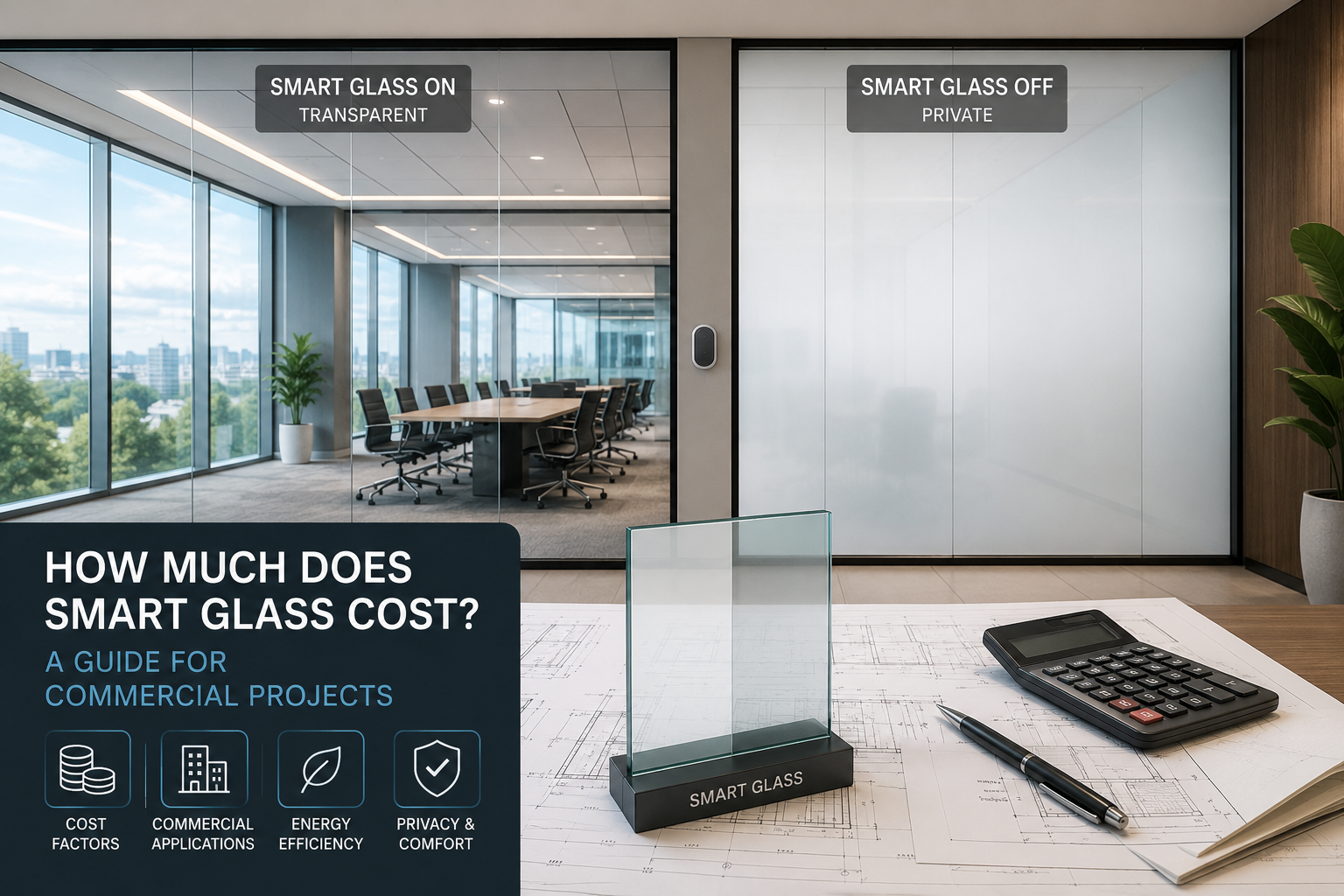
Smart glass is becoming an increasingly popular choice for offices, healthcare facilities, hospitality spaces, conference rooms, and other modern commercial environments. Its ability to provide privacy, control light, and support clean architectural design makes it an attractive alternative to conventional glass combined with blinds or curtains.
One of the first questions architects, designers, contractors, and building owners ask, however, is: How much does smart glass cost?
There is no single price that applies to every project. Smart glass pricing depends on the technology, glass configuration, panel dimensions, controls, electrical requirements, customization, and complexity of the project. Industry pricing guides show substantial variation for exactly these reasons.
Understanding these factors early in the design process can make it much easier to budget for smart glass and determine whether it is the right solution for a commercial project.
What Is Smart Glass?
Smart glass is an architectural glass technology that can change its light transmission, tint, or privacy characteristics.
Depending on the technology, the glass may transition from transparent to opaque, change tint levels, or control the amount of light and solar energy entering a building.
Several technologies fall under the broader smart glass category, including:
- PDLC (Polymer Dispersed Liquid Crystal)
- Electrochromic glass
- SPD (Suspended Particle Device) glass
- Other dynamic and switchable glazing technologies
Because these technologies perform differently and require different manufacturing and control systems, the type of smart glass selected can have a major impact on project cost.
How Much Does Smart Glass Cost?
Smart glass should generally be treated as a project-specific architectural product rather than a product with one universal price per square foot.
Published market estimates vary considerably. Some consumer-oriented 2026 pricing guides place installed smart glass broadly around $50–$150 USD per square foot, while other suppliers publish different material-only prices. These figures should be considered general market references rather than quotations for a Clearstream Architectural project.
For commercial architecture, the final cost can change substantially depending on the specifications.
A large conference-room partition using standard rectangular panels, for example, will have very different requirements from a custom exterior glazing system with specialized controls and complex panel dimensions.
For that reason, architects and contractors should obtain pricing based on the actual project specifications rather than relying exclusively on generic online cost-per-square-foot estimates.
What Factors Affect Smart Glass Cost?
1. Smart Glass Technology
The technology selected is one of the biggest factors affecting cost.
PDLC smart glass is commonly used where instant privacy is required. It can switch between transparent and opaque states and is particularly suitable for interior partitions, conference rooms, healthcare environments, and similar applications.
Electrochromic glass is generally designed to control tint and solar transmission rather than simply switching between transparent and private states.
SPD technology provides adjustable light transmission and can be used where dynamic shading is required.
Each technology has different manufacturing, electrical, control, and performance requirements, so pricing can vary significantly.
2. Smart Glass vs. Smart Film
Another important consideration is whether the project requires manufactured smart glass or a switchable film applied to an existing glass surface.
Smart film can sometimes provide a lower-cost retrofit option when suitable glass is already installed.
Factory-manufactured smart glass, on the other hand, integrates the switchable technology into the glass assembly and may be preferable for new architectural projects or applications with specific safety and performance requirements.
Published pricing from manufacturers and installers consistently shows a substantial cost difference between retrofit film and complete laminated smart glass systems.
The correct choice should be based on project requirements rather than price alone.
3. Glass Size and Total Project Area
As with most architectural glazing products, panel dimensions and total square footage influence pricing.
A small privacy panel requires much less material than a floor-to-ceiling glass partition spanning several offices.
Large commercial projects may also involve:
- Multiple panels
- Custom dimensions
- Additional electrical connections
- More complex framing
- Specialized transportation and handling
Total project size should therefore be established as early as possible when requesting pricing.
4. Custom Shapes and Glass Specifications
Standard rectangular panels are generally simpler to manufacture than custom architectural shapes.
Project costs may increase when designs require:
- Oversized panels
- Custom shapes
- Curved glass
- Cut-outs
- Specialized edges
- Custom tinting
- Additional laminates
- Safety glazing configurations
- Specialized performance requirements
Custom fabrication can be an important part of achieving the architectural vision, but it should be considered during early budgeting.
5. Electrical and Control Systems
Unlike conventional glass, many smart glass technologies require electrical components.
Depending on the system, a project may need:
- Power supplies
- Transformers or controllers
- Wall switches
- Remote controls
- Building automation integration
- Wiring concealed within framing systems
More sophisticated control systems can increase the overall project cost. Installation planning should therefore involve both glazing and electrical requirements.
6. Installation Complexity
Installation can represent a significant portion of the overall smart glass investment, particularly for complex commercial projects. Industry pricing guides note that labor, electrical work, site access, and integration requirements can materially change the final installed price.
Factors may include:
- Accessibility of the installation area
- Existing framing conditions
- Electrical access
- Number and size of panels
- New construction vs. retrofit
- Coordination with other trades
- Building height and site conditions
Considering these requirements during the design stage can help avoid unexpected complications later.
Where Is Smart Glass Worth the Investment?
Smart glass is not necessary for every glass application. It provides the most value where its ability to control privacy, transparency, or light solves a specific design problem.
Office and Conference Room Partitions
Conference rooms are one of the most common applications for switchable privacy glass.
A transparent glass meeting room can maintain an open-office appearance during normal use and switch to privacy mode when confidential meetings take place.
This can eliminate the visual clutter associated with blinds and other conventional privacy solutions.
Healthcare Facilities
Privacy is especially important in healthcare environments.
Switchable glass can be considered for patient rooms, consultation spaces, treatment areas, and other environments where visibility and privacy requirements change throughout the day.
Hospitality Projects
Hotels and hospitality spaces can use smart glass to create flexible room layouts and distinctive design features.
Applications may include bathrooms, meeting rooms, suites, spas, and other areas where on-demand privacy adds value to the guest experience.
Executive Offices
Smart glass partitions can provide privacy for executive offices without permanently blocking natural light or reducing visual openness.
Commercial Interiors
Architects can also integrate smart glass into reception areas, flexible workspaces, presentation rooms, and other premium commercial interiors.
Is Smart Glass More Expensive Than Regular Glass?
Yes. Smart glass generally costs more than conventional architectural glass because it incorporates additional materials, technology, manufacturing processes, controls, and electrical components. Current market guides consistently price smart glass above conventional glazing.
However, comparing the material price alone does not always provide the complete picture.
A traditional glass partition may require additional:
- Blinds
- Curtains
- Privacy films
- Mechanical shading systems
- Cleaning and maintenance
Smart glass can integrate privacy control directly into the glazing system.
For certain projects, the architectural simplicity and functionality may justify the higher initial investment.
Does Smart Glass Help With Energy Efficiency?
Some smart glazing technologies can help manage solar heat and daylight entering a building.
Dynamic glazing can reduce unwanted solar gain or glare while maintaining access to natural light. Research into dynamic glazing has demonstrated that appropriately designed switchable systems can influence building heating and cooling loads, although actual savings depend heavily on the technology, climate, building design, orientation, and control strategy.
Energy performance should therefore be evaluated as part of the complete building design rather than assuming that every smart glass installation will produce the same savings.
Smart Glass Cost vs. Long-Term Value
For architects and developers, the more useful question is often not simply:
“How much does smart glass cost?”
but:
“What value does smart glass provide for this particular space?”
The potential value can include:
- On-demand privacy
- Clean architectural aesthetics
- Flexible use of interior spaces
- Reduced reliance on blinds and curtains
- Better control of daylight and glare with certain technologies
- Integration with modern building controls
- A distinctive experience for occupants and visitors
For premium commercial environments, these benefits can make smart glass an important architectural feature rather than simply another glazing material.
How to Budget for Smart Glass in a Commercial Project
Architects and contractors considering smart glass should gather several pieces of information before requesting pricing:
- Approximate glass dimensions
- Number of panels
- Interior or exterior application
- Required privacy or shading function
- Preferred smart glass technology
- Glass safety requirements
- Framing system
- Electrical requirements
- Control method
- Project location
- Installation schedule
Providing these details makes it easier to identify an appropriate system and obtain meaningful project-specific pricing.
Smart Glass Solutions for Commercial Projects in Canada
Clearstream Architectural works with architects, designers, engineers, glazing contractors, and builders to identify specialized architectural glass solutions for commercial projects.
From switchable privacy glass for office interiors to advanced glazing technologies for larger architectural applications, the appropriate solution depends on the project’s design goals, performance requirements, and budget.
For projects in Ontario and across Canada, discussing smart glass requirements early in the specification process can help determine which technology and configuration are best suited to the application.
Planning a Smart Glass Project?
The cost of smart glass varies considerably from one project to another, which is why an accurate estimate requires more than simply knowing the square footage.
Glass type, technology, dimensions, controls, electrical requirements, installation conditions, and performance specifications all contribute to the final cost.
If you are planning a commercial project and considering smart glass, contact Clearstream Architectural to discuss your requirements and explore suitable architectural glass solutions.
📍 Dundas, Ontario, Canada
📞 (905) 570-3166
Whether you are designing an office, healthcare facility, hospitality environment, or another commercial space, choosing the right smart glass system early can help balance performance, aesthetics, functionality, and project budget.